
There's no legal rule about who has the children at Christmas after separation. Parents agree it between themselves, and common arrangements include alternating Christmas Day each year, splitting the day, or holding two Christmases. Agree it by early autumn, because mediation takes weeks to arrange and a court application usually takes months.
The first Christmas after a separation is often the hardest. Children notice the change more than at any other time of year, and so do parents. What helps most is a plan that's settled early, written down and explained to the children well before the school term ends.
Who has the children at Christmas after separation?
Whoever the two of you agree should have them. If you were married when the child was born, or registered the birth together, you'll usually both have parental responsibility (GOV.UK), and neither of you has an automatic right to Christmas Day. If there's already a child arrangements order, check what it says: many set out holidays and special days, and you should follow it unless you both agree to change it.
If a court ever has to decide, the only question is what's best for the child. The child's welfare is the court's "paramount consideration" under the Children Act 1989, and the court must also weigh up the child's own wishes and feelings in the light of their age and understanding (legislation.gov.uk). Which parent "deserves" Christmas doesn't come into it.
What are the usual Christmas arrangements for separated parents?
Most families end up with one of four patterns. None is right for everyone, and what works when children are four may not work when they're fourteen.
- Alternating years. One parent has Christmas Eve and Christmas Day this year, the other has them next year, and the second parent has Boxing Day or New Year instead. It's easy to keep to, because everyone knows where they stand years ahead.
- Splitting the day. The children wake up in one home and move to the other after lunch. It works when the homes are close together and handovers are friendly. It works badly when there's a long drive or tension on the doorstep.
- Two Christmases. The children have Christmas Day in one home and a second Christmas, with presents and a dinner, on another day. Younger children often love this. Older children may find it more of a performance.
- Together. Some parents spend part of the day together for the children's sake. It can be lovely if you genuinely get on. If you don't, children pick up the strain quickly, so be honest with yourselves.
Here's how alternating years might look over two Christmases, written down the way you'd put it in a parenting plan:
| Year | Christmas Eve to midday Boxing Day | Midday Boxing Day to 28 December |
|---|---|---|
| 2026 | Parent A | Parent B |
| 2027 | Parent B | Parent A |
Write down the handover times and who drives, not only the dates. Most Christmas arguments are about the details: what time "Boxing Day" starts, or whether the children can stay for the grandparents' visit.
When should separated parents agree Christmas?
By September or October if you can. That gives you time to try mediation if talking doesn't work, to book travel, and to tell the children what's happening before the excitement of December. It also means both of you can make plans with your own families without last-minute changes.
Put the agreement in writing. Cafcass, the service that advises the family courts on children, has a free online tool called Our Child's Plan that covers school holidays, bank holidays and time with family on special occasions (Cafcass). If you ever did go to court, a judge would expect you to have tried to agree a plan like this. Our guide to co-parenting after divorce covers how to keep a plan working once it's agreed.
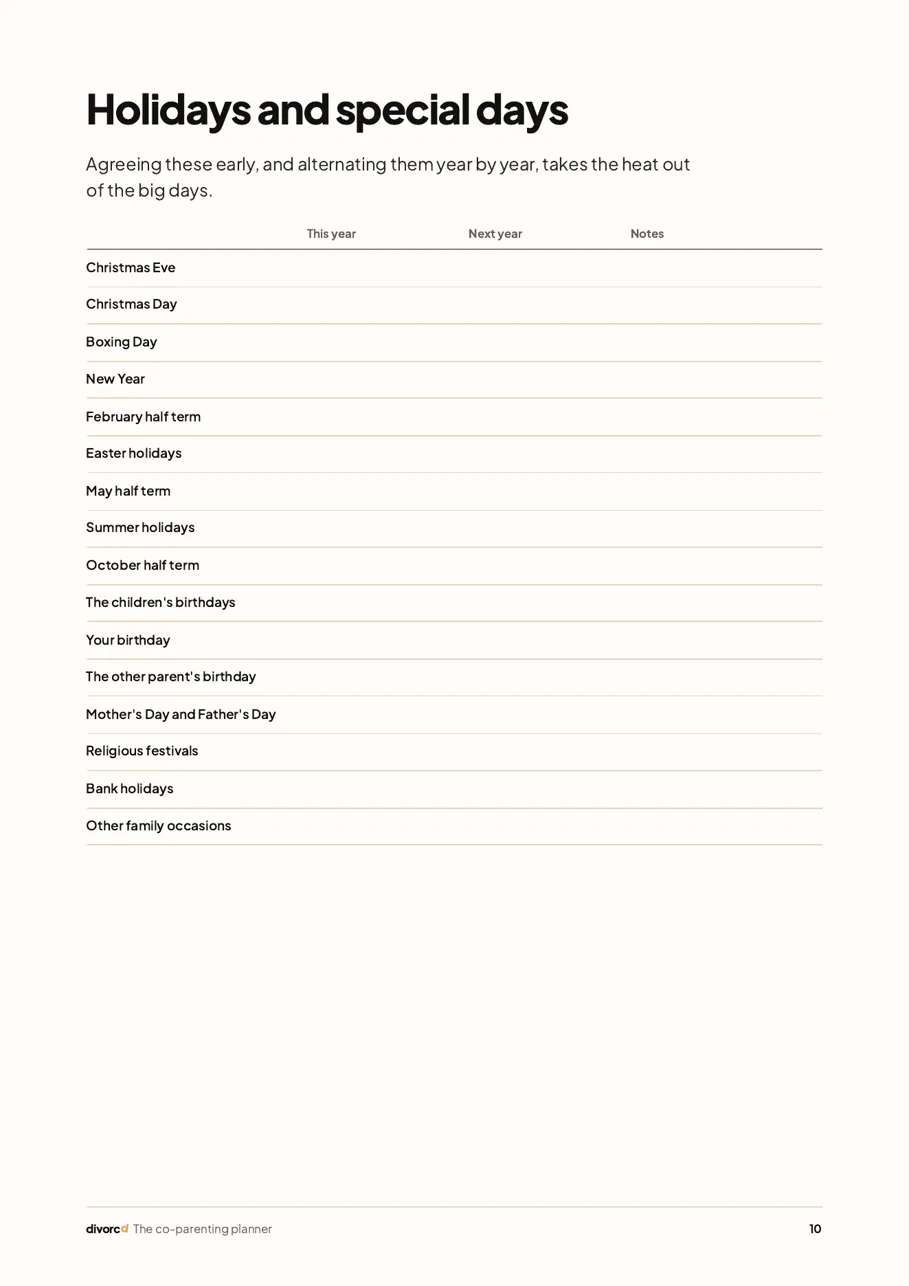
Agree Christmas once, for the next few years
The co-parenting planner has a page for holidays and special days that alternates year by year, plus a year planner to colour in, so both homes are working from the same dates.
See the co-parenting planner£12, instant downloadWhat if we can't agree about Christmas?
Try mediation first. A family mediator helps you both reach an arrangement without going to court. You'll each start with a Mediation Information and Assessment Meeting (MIAM), which usually costs around £120, or nothing if either of you qualifies for legal aid. For disputes about children, the government's voucher scheme can pay up to £500 towards the mediation sessions themselves (GOV.UK). Our guide to what divorce mediation costs explains the voucher and legal aid in detail, and you can find an accredited mediator near you.
A court application is the last resort. You apply on form C100 for a child arrangements order, or for a specific issue order if it's a one-off question such as a trip. The fee is £270, and you'll usually need to have attended a MIAM first unless an exemption applies (GOV.UK). Help with Fees can cover some or all of the fee if you're on a low income: see our guide to help with court fees.
The timing matters. GOV.UK says an application usually takes around 10 months, and Ministry of Justice figures show private law children cases took an average of 33 weeks to complete in April to June 2026 (Ministry of Justice). Courts can act quickly when a child is at risk, but an application made in November about this Christmas is unlikely to be decided in time. If you're heading that way, our guide to applying for a child arrangements order without a solicitor walks through the form.
The best Christmas arrangement is the one the children can count on, agreed early enough that nobody's arguing about it in December.
Can I take the children abroad for Christmas?
Only with the permission of everyone who has parental responsibility, or of a court. Taking a child abroad without it is child abduction. The one exception: if a child arrangements order says the child lives with you, you can take them abroad for up to 28 days without permission, unless another order says otherwise (GOV.UK).
Ask early and get the permission in writing. GOV.UK suggests a letter from the other parent with their contact details and details of the trip, and it helps to carry the child's birth certificate if you have a different surname. Our guide to taking children abroad after separation goes through it step by step.
How should separated parents handle Christmas presents?
Talk about presents before you buy them. A short message in November saves a lot of hurt on the day. Things worth agreeing:
- Big presents. A first phone, a games console or a pet affects both homes. Agree who's buying it and what the rules are.
- Roughly what you'll each spend. Children notice when one home has far more under the tree, and it can leave them feeling caught in the middle.
- A present for the other parent. Helping younger children buy or make something for their other parent shows them they're allowed to love you both.
- Where presents live. Let children take new things between homes. Telling them a present has to stay at yours turns it into a point of conflict.
Should the children have a say?
Yes, in a way that suits their age, but they shouldn't have to choose. Asking a seven-year-old "where do you want to spend Christmas?" puts them in an impossible position. Asking what matters most to them about Christmas is different: it might be the stocking, seeing their cousins or a film on Christmas Eve, and you can build the plan around it.
Teenagers will usually have firmer views, and the law expects them to be taken seriously. Cafcass suggests sharing a child-friendly version of your plan and welcoming their feedback. If you haven't yet explained the separation itself, start with our guide on how to tell your children.
If you're worried about your safety or the children's
Your safety comes first. If there's been domestic abuse, you don't have to negotiate Christmas face to face, and you don't usually need to attend a MIAM before applying to court. The National Domestic Abuse Helpline, run by Refuge, is free and open 24 hours on 0808 2000 247 (Refuge). In an emergency, call 999. Our safeguarding page lists helplines for men and for every UK nation.
Handovers can be arranged so you don't meet, for example at school before the holidays or through a trusted relative. If the other parent makes contact difficult in other ways, our guide to dealing with a difficult ex may help, and child arrangements after divorce explains how courts handle safety concerns, including form C1A.
Getting through your first Christmas apart
If the children are with the other parent this year, plan your own day before it arrives. Spend it with people who are good for you, or do something entirely different. Keep calls to the children short and cheerful at a time you've agreed, so they can enjoy where they are. And remember that next year the pattern swaps.
Want help agreeing Christmas?
Tell us what's going on and we'll introduce you to two or three accredited mediators or family solicitors near you. The introduction is free, and they'll tell you their fees before you agree to anything.
Get matchedCommon questions
Who gets the children on Christmas Day after a separation?
There's no automatic rule. Parents agree it between themselves, and many alternate Christmas Day each year. If there's a child arrangements order, follow what it says. If a court has to decide, it does what's best for the child.
Is it better to split Christmas Day or alternate years?
It depends on how far apart you live and how well handovers go. Splitting the day suits parents who live close by and get on. Alternating years is easier to keep to and avoids a handover on Christmas Day itself.
Can my ex stop me seeing the children at Christmas?
If you both have parental responsibility, neither of you can decide alone. Try to agree, then try mediation. If that fails, you can apply to court on form C100, but a court application usually takes around 10 months, so start early.
Do I need permission to take my child abroad for Christmas?
Yes, from everyone with parental responsibility, or from a court. The exception is if a child arrangements order says the child lives with you: then you can go abroad for up to 28 days unless another order says otherwise.
What if it isn't safe to agree Christmas with my ex?
You don't have to negotiate face to face. If there's been domestic abuse you won't usually need to attend a MIAM before applying to court. The National Domestic Abuse Helpline is free and open 24 hours on 0808 2000 247. In an emergency, call 999.
Sources
- legislation.gov.uk, Children Act 1989, section 1
- GOV.UK, Making child arrangements if you divorce or separate: mediation
- GOV.UK, Apply for a court order about child arrangements
- GOV.UK, Family court fees (EX50), updated 13 July 2026
- Ministry of Justice, Family Court Statistics Quarterly: April to June 2026
- Cafcass, How Our Child's Plan can help
- GOV.UK, Who has parental responsibility
- GOV.UK, Taking your child abroad
- Refuge, National Domestic Abuse Helpline
Keep reading
This guide is general information, not legal or financial advice. Laws, fees and figures change, so check the sources above and speak to a qualified professional about your situation. Facts checked 20 October 2026.