
Divorcing after 50 follows the same legal process as any divorce in England and Wales. What changes is the money. With less time to rebuild savings, the pension is often worth more than the house, the State Pension rules depend on your age, and maintenance can last for life. Get every pension valued before you agree anything, and update your will and powers of attorney as soon as you separate.
More people are separating later in life. The Office for National Statistics found that between 2005 and 2015 the number of men divorcing at 65 or over rose by 23% and the number of women by 38%, while divorces overall fell by 28% (ONS). Marriages that end are also lasting longer: the median opposite-sex marriage ending in divorce in 2025 had lasted 13.0 years, the longest since records began in 1963 (ONS). The ONS stopped recording age at divorce in 2020, so there are no newer age figures (ONS).
After a long marriage, the pension decisions are the ones you can't easily undo. Get matched with a financial adviser or family solicitor who deals with pensions on divorce. It's free.
Why the pension often matters more than the house
The Family Justice Council says pension funds may be worth more than the family home, and that after a long marriage with large pensions, dividing them to meet each person's needs in retirement can be the biggest issue in the case (Family Justice Council). The same guide says that where there is more than enough to meet both people's needs, equal sharing is likely to be seen as fair, particularly after a long marriage.
Often one person, usually the one who stayed at home or worked part time, has a much smaller pension. Keeping the house in exchange for giving up any claim on the pension can feel safer, but a house doesn't pay an income. A pension can be shared by court order, offset against other assets or paid out through an attachment order once it's drawn; our guide to pensions in divorce explains each option. MoneyHelper, the government-backed guidance service, also offers free appointments with pension specialists for people divorcing (MoneyHelper).
Final salary pensions and the pension on divorce expert
You can ask every scheme for a cash equivalent transfer value (CETV). For a pension pot, the CETV is broadly what the pot is worth. For final salary and other defined benefit schemes, including most public sector pensions, it can be badly misleading.
The Pension Advisory Group, a group of family judges and pension and family law specialists, publishes guidance on how pensions should be treated on divorce, with a foreword from the President of the Family Division. Its second edition says (Pension Advisory Group):
- where the combined CETVs of defined benefit pensions exceed £100,000, splitting them equally by CETV can lead to very unexpected outcomes and specialist input is needed
- in a needs-based case with defined benefit CETVs above £200,000, a report from a pensions on divorce expert (a PODE) will usually be necessary
- defined benefit CETVs often undervalue the benefits the pension holder will actually receive
- uniformed public service schemes, such as the armed forces and police, need expert input whatever your ages
A PODE, usually an actuary or specialist adviser, can work out what share would give you both equal incomes in retirement, which is often a very different percentage from an equal split of the CETV. Agreeing to instruct one expert jointly keeps the cost down.
On a final salary pension, an equal split of the transfer value rarely means an equal income in retirement.
The State Pension: what can and can't be shared
The rules depend on whether you reached State Pension age before 6 April 2016 (the old rules) or on or after it (the new State Pension). The table summarises what the Pension Advisory Group guide says about each part (Pension Advisory Group).
| Part of the State Pension | On divorce |
|---|---|
| Basic State Pension (old rules) | Can't be shared. If you reached State Pension age before 6 April 2016, you may be able to substitute your ex's National Insurance record for your own to raise your basic State Pension, without reducing theirs. |
| Additional State Pension (SERPS and State Second Pension) | Can be shared by a pension sharing order where the person who built it up reached State Pension age before 6 April 2016, or where the divorce application was issued before that date. |
| Protected payment (new rules) | Where someone's starting amount in April 2016 was above the full new State Pension, the extra (the protected payment) can be shared. |
| New State Pension | Can't be shared, and you can't use your ex's record to increase it. |
| Graduated Retirement Benefit | Has never been shareable. |
GOV.UK confirms that a court can order additional State Pension or a protected payment to be shared, and that the person receiving the share gets an extra payment on top of their own State Pension (GOV.UK). You ask the Pension Service for a valuation using form BR20 (GOV.UK).
Check your National Insurance record
The full new State Pension is £241.30 a week, and you usually need 35 qualifying years of National Insurance to get it (GOV.UK). You need at least 10 qualifying years to get any (Pension Advisory Group). Check your State Pension forecast on GOV.UK to see your record and any gaps. You can usually pay voluntary contributions to fill gaps from the past six years (GOV.UK).
If you stayed at home with children, look closely. The Pension Advisory Group notes that National Insurance credits for parents went to whoever claimed Child Benefit. If your spouse claimed it while working, you can apply to have those credits moved to your record using forms CF411 and CF411A. A gap of around £20 a week or more between your State Pensions can justify a pension share even against a modest private pension.
Spousal maintenance after a long marriage
The Family Justice Council says that where a couple divorce after a very long marriage, during which one of them stayed at home to bring up children or run the home, that person is unlikely to be able to return to full-time work and support themselves, and the court usually makes an open-ended order (Family Justice Council). The same guide accepts that financial independence may not be achievable when one of you is older.
Maintenance ends if the person receiving it remarries or forms a civil partnership, or if either of you dies (Matrimonial Causes Act 1973, s28). Because payments stop on the payer's death, ask your solicitor whether life insurance or a larger pension share would protect you better. Our guide to spousal maintenance explains how the amount and length are decided.
The house and downsizing
After a long marriage the home is often owned outright or close to it, and the children have left, so selling and buying two smaller homes is common. Before you agree, check what each of you could actually buy or rent with your share where you want to live, and whether you could borrow at your age. Think about later life too: stairs, transport and distance from family. Our guides to what happens to the house and splitting money and property explain the options, the tax rules and how a court looks at housing needs.
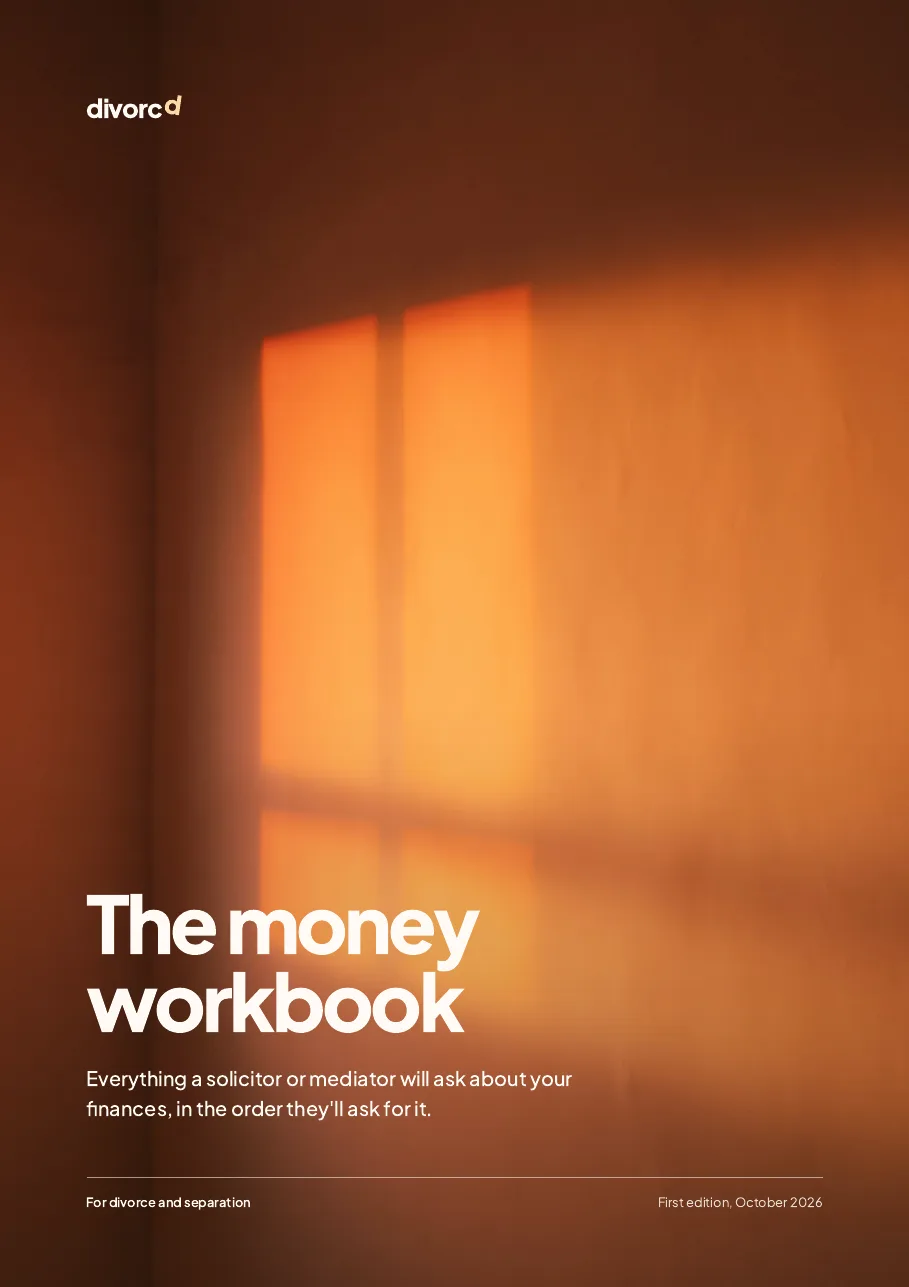
List every pension and property in one place
The money workbook has pages for every pension and its valuation, your property and savings, and a monthly budget for life on your own, plus a letter to copy asking each scheme for a CETV.
See the money workbook£19, instant downloadTelling adult children
Grown-up children are often more shaken by a parent's divorce than people expect. They may worry about the parent who will be living alone, or feel pushed to take a side.
- Tell them yourselves, and together if you can, before they hear it from someone else. Keep the explanation short and agreed between you.
- Don't make them go-betweens or confidants about money, blame or a new partner. They are still your children, whatever their age.
- Talk about practical things early, such as family occasions and the family home.
- Agree how you'll each keep seeing grandchildren.
Our guide on how to tell your children about divorce is written mainly for younger children, but much of it still applies.
Wills, inheritance and lasting powers of attorney
- Until the final order, your spouse can still inherit. Separation alone doesn't change your will, and under the rules for people who die without a will, a husband, wife or civil partner can inherit even if you were separated (Citizens Advice). Make a new will as soon as you separate if that isn't what you want.
- After the final order, your will is read as if your ex had died on the date of the divorce. Gifts to them, and their appointment as executor or trustee, fall away, unless the will says otherwise. The rest of the will still stands (Wills Act 1837, s18A).
- If you remarry, marriage cancels any will you made before (GOV.UK).
- Lasting powers of attorney. If your spouse is your attorney, the divorce ends their appointment, unless the LPA says it should continue (Mental Capacity Act 2005, s13). Registering a new LPA costs £92, or £184 for both the health and welfare and the property and financial affairs types, with reductions for people on low incomes (GOV.UK).
- Pension nominations. Update the expression of wish form for each pension and any life insurance, so death benefits don't go to your ex by default.
Our after-divorce checklist lists the other accounts and records to update.
Health, care and benefits in later life
If one of you has a serious health condition, tell your solicitor and any pension expert: the Pension Advisory Group notes that an enhanced pension may be available. In England, if you have more than £23,250 in savings and other capital, you'll usually pay for your own care (Age UK). How your savings and property are divided can therefore affect whether either of you gets help with care later. Remember to update your next of kin with your GP and employer.
Pension Credit and other help
Once you live apart, you claim benefits as a single person. If you've reached State Pension age, Pension Credit tops up your weekly income to £238 if you're single, or £363.25 for a couple (GOV.UK). It also opens the door to Housing Benefit, Council Tax Reduction, help with NHS costs and a free TV licence if you're 75 or over. You may still qualify with a higher income if you have a disability, care for someone or have housing costs, so check even if you think you won't (GOV.UK).
A pension share or lump sum can affect means-tested benefits, so ask your adviser how the settlement will interact with them. If you're under State Pension age, our guide to divorce and benefits covers Universal Credit and what to report. The Age UK Advice Line is free on 0800 678 1602, 8am to 7pm, every day of the year, and can help with benefits, housing and care (Age UK).
Loneliness, friendship and dating again
Living alone for the first time in decades can be harder than the legal process, and friendships built as a couple sometimes drift. Put a few fixed things in the week, such as a class or a regular call with a friend, before you need them.
If you're 55 or over and want someone to talk to, The Silver Line Helpline, run by Age UK, is free on 0800 4 70 80 90, 24 hours a day, every day of the year (Age UK). Samaritans are there for anyone, any time, on 116 123.
When you feel ready to meet someone new, be wary of anyone online who quickly talks of love or asks for money. Our guide to dating after divorce covers safety and spotting romance scams, and finding your confidence again has practical ideas for the first year on your own.
Want someone to check the pensions with you?
Tell us what's going on and we'll introduce you to two or three experts near you. The introduction is free, and they'll tell you their fees before you agree to anything.
Get matchedCommon questions
What is a grey divorce?
Grey divorce is an informal name for divorce later in life, usually after 50 and often after a long marriage. The law is the same as for any divorce, but pensions, retirement income and health tend to matter more.
Am I entitled to half my husband's or wife's pension?
Not automatically. After a long marriage, pensions built up during the marriage are usually part of what is shared, but the court looks at both your needs in retirement. A pension can be shared, offset against other assets or, less often, paid out through an attachment order.
Can I get my ex's State Pension after divorce?
The basic and new State Pension can't be shared. If you reached State Pension age before 6 April 2016, you may be able to use your ex's National Insurance record to increase your basic State Pension. Some additional State Pension, or a protected payment, can be shared by court order.
Do I need a pension expert's report?
Often, if either of you has a final salary or other defined benefit pension. The Pension Advisory Group says specialist input is needed where the combined transfer values of defined benefit pensions exceed £100,000, and a report will usually be necessary above £200,000 in a needs-based case.
Does divorce cancel my will?
Not entirely. Once the final order is made, your will is read as if your ex had died on that date, so gifts to them and their appointment as executor fall away. The rest of the will stands. Until the final order, your spouse can still inherit, so review your will as soon as you separate.
Sources
- Office for National Statistics, Marriage and divorce on the rise at 65 and over (July 2017)
- Office for National Statistics, Divorces and dissolutions in England and Wales: 2024 and 2025 (September 2026)
- Office for National Statistics, Ages at divorce from 1950 to present (freedom of information response)
- Pension Advisory Group, A guide to the treatment of pensions on divorce, second edition (Nuffield Foundation, 2024)
- Family Justice Council, Sorting out Finances on Divorce (March 2024)
- MoneyHelper, How to split pensions in a divorce or dissolution
- GOV.UK, The new State Pension: inheriting or increasing State Pension from a spouse or civil partner
- GOV.UK, Additional State Pension: if you get divorced
- GOV.UK, The new State Pension: what you'll get
- GOV.UK, Check your State Pension forecast
- GOV.UK, Voluntary National Insurance: deadlines
- legislation.gov.uk, Matrimonial Causes Act 1973, section 28
- Citizens Advice, Who can inherit if there's no will
- legislation.gov.uk, Wills Act 1837, section 18A
- GOV.UK, Making a will: updating your will
- legislation.gov.uk, Mental Capacity Act 2005, section 13
- GOV.UK, Make, register or end a lasting power of attorney: register
- Age UK, Changes to social care
- GOV.UK, Pension Credit: what you'll get
- GOV.UK, Pension Credit: eligibility
- Age UK, Age UK Advice Line
- Age UK, The Silver Line Helpline
Keep reading
This guide is general information, not legal or financial advice. Laws, fees and figures change, so check the sources above and speak to a qualified professional about your situation. Facts checked 25 October 2026.